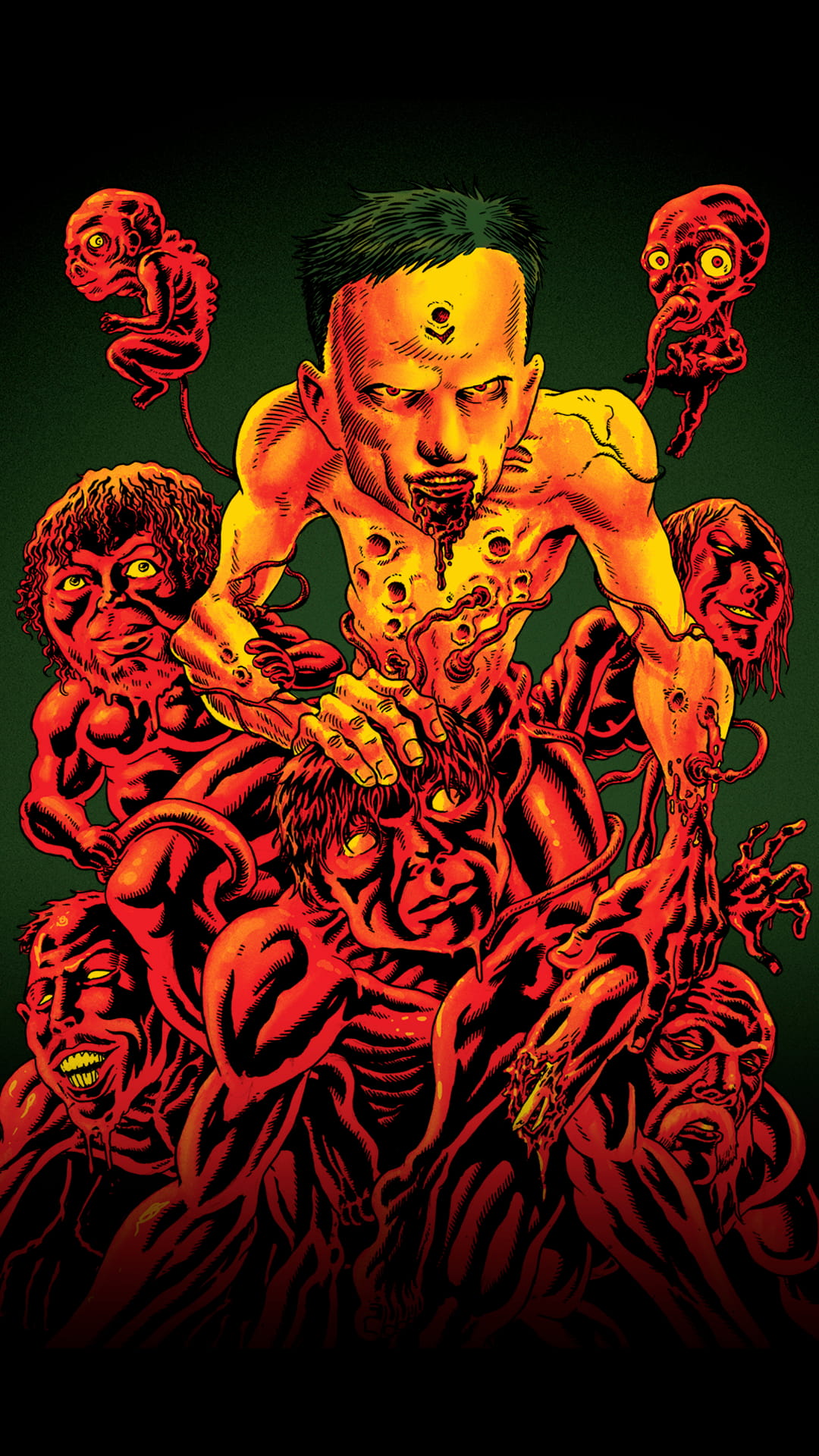
It started when the Eater noticed his hair had receded six millimeters from baseline. The wrinkles came soon after, radiating from the corners of his eyes. He’d stand at the mirror and pull at his skin, making the striations vanish. Every line announced to him that his body was breaking apart, the cells oxidizing, the elasticity breaking down, the telomeres shortening.
This weak flesh was dying. But he would not die. He was smarter than death. He would defeat it.
Someday, he knew, he would cross the bridge into another dimension. He would upload his consciousness to a machine and live forever. He began to build the neural networks that would allow him to best God and anyone who doubted him.
But he could not allow this flesh shell to fail.
And so began the hunger. Late at night he would leave the confines of his fluorescent office and prowl the sodium lamps of San Francisco, searching, seeking the youngest, the strongest, and, at first, the willing.
He would convince them to stitch their veins into his. He would pay them of course, because he was always happy to pay them, and in exchange they would supply him with a steady flow of their youthful blood. Their vigorous kidneys and liver would cleanse the blood, and their strong hearts would pump the fresh, young blood into his body.
He would drag them with him wherever he went, always feeding him. And as he ingested their selves, he found himself surging with a deep feeling of disgust at these bags of blood feeding into him, these fools who gave themselves over to him.
But the blood was not enough to fight the hours and days that ate at his body. His skin stayed sallow, his hair went whisper-thin, his eyes hollowed deeper. He began to sweat at the slightest thing—the light of the sun, the slightest irritation, a troublesome question.
To stave off his decaying DNA, he needed more. If blood was not enough, he would replace his flesh with their flesh. He would consume their minds to keep his sharp.
His hunger blossomed, metastasizing, and he grew to hate who he ate.
He was hungry, but he was weak. He had no strength of his own—in his body or his soul—to kill. And so few were willing to part with flesh and bone.
But the machine he was building to cheat Death had other uses. As it gathered the data he would need to find his own escape, it began to see.
How far it could see! Across the world, and even the near future. Through the crystal sphere at the machine’s core, he could see. So his machine began collecting the information to help him feed.
It could predict where the murder rate would increase, so he could find fresh kills to collect. It showed him where bombs would fall, so he could feast on more flesh. It told him where maternal mortality would rise, where the supply of fresh stem cells would be plentiful.
With each bite he consumed, the Eater could feel himself getting younger, and his hate blooming. He could feel the enamel of his teeth hardening, the whites of his eyes brightening, the lobes of his ears tightening, and the fire in his gut thriving. He would cheat Death. He would defy God.
The hunger rages through him, pulsating, amplifying. He hates them. The ones too weak to stop death. The ones too weak to cheat him. They are sheep and weaklings, who obey this silly law they call nature or God.
He eats not just to make himself young. He eats to rid himself and the world of everyone he hates. He gazes into his crystal orb, chewing the ripped flesh, crunching a fresh bone. The machine is not ready to take him, and he is not ready. He eats, turning his clock back so he can live until his machine is ready, until he can transcend God’s law. But first, he must eat those who would stop him, who dare doubt him, everyone unworthy to walk on his earth.
The Eater is just a scary story kids tell around the campfire. A creepy joke in the back of a satire magazine. But the real Peter Thiel is far scarier than you can imagine.